Avatars in advertising: Why Gucci used Genies to appeal to Gen Z
“Current day digital marketing primarily consists of monotonous and passive scrolling through newsfeeds and ads, but marketers should be looking at these tools as ways to break into a more active and personalized way to engage with their customers,” says Managing Director of Genies. How brands like Gucci are using their technology to connect with younger audiences.
Much has been made of millennials as murderers of old media. To date, they’ve killed everything from television commercials to newspapers — really everything but avocado toast.
However, as millennials reach their thirties, marketers have had plenty of time to find tried-and-true methods of getting millennials to respond to marketing.
But Gen Z — those born from around 1996 to the present — are a whole new mystery.
That’s because even the oldest of this age group can barely remember a time before smartphones and social media, which has fundamentally changed the ways in which they communicate, even more so than millennials.
And as marketers begin to feel confident in the ways they’re connecting with late twenty or thirty-somethings, reaching out to Gen Z on platforms like Snapchat and Instagram presents a new challenge.
Avatars provide one interesting option for personalizing messaging for an incredibly visual, mobile-driven audience. Here are some of the reasons many brands are exploring the possibilities avatars offer.
As a generation that has pretty much always communicated via smartphone or tablet keyboard, Gen Z speaks an entirely new technological language that’s built around pictures, like emojis. But emojis are just the beginning.
In a recent HuffPost article, senior editor Christine Roberts wrote about how the publication, hoping to promote itself to a younger audience, introduced a “throwback sticker pack” to promote its HuffPost Entertainment chat. Users could download the sharable stickers while at the same time following the chat.
According to HuffPo, this was one of their most used stickers, for example
The promotion resulted in 700,000 new followers, many of them from the coveted Gen Z demographic.
But stickers and emojis are just the beginning. Creating influencer and branded avatars is an incredibly interesting new way marketers are breaking through to a visually-focused demographic.
But getting celebrities like Cardi B or Justin Bieber to promote a product in person is pretty much out of reach for most brands. Even social media influencers with thousands of followers are pretty expensive.
That’s why an “avatar agency” called Genies turned to avatars to connect influencers, brands, and Gen Z using interactive, customizable avatars:
“The Avatar Agency essentially represents both talent and brands in the digital world,” says managing director of Genies, Allison Sturges.
“For talent, they are able to have “representation” in their digital form where their Genie can take their place instead of the physical person needing to be present, which allows them to take on even more opportunities without needing to take time away from studio, the court, or the field.
We work with talent like J Lo, Lil Nas X, Russell Westbrook, Jared Goff, and Amanda Cerny to help fulfill their personal brand obligations as well as bring in more partnership opportunities to them, so that they can actually make money with their Genies.”
Brands can access this talent network in order to find the right influencer for their campaign, then integrate that campaign into the company’s consumer app through branded wheels and topical actions.
Many notable brands, even those with the budgets to hire big names for campaigns, are jumping on the opportunity to experiment with avatars, with or without the involvement of influencers.
Case in point: How Gucci used avatars to connect with a younger audience
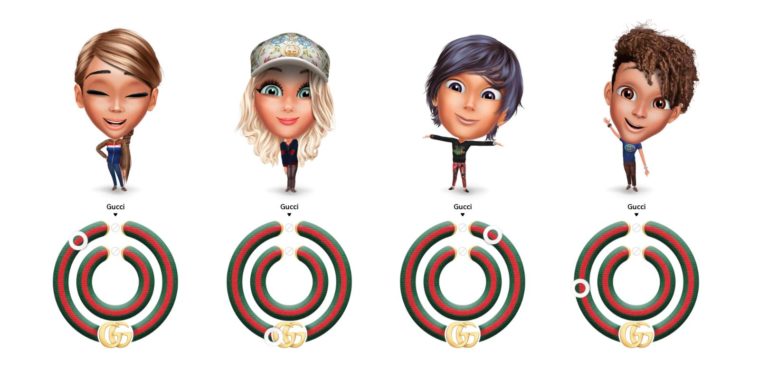
High-end fashion house Gucci isn’t exactly a teeny-bopper brand. But when the company wanted to reach out to Gen Z, they partnered with Genies to help users create 3-D “clones” of themselves, matching skin tone, hair color, and even likes and dislikes through the customizable wheel.
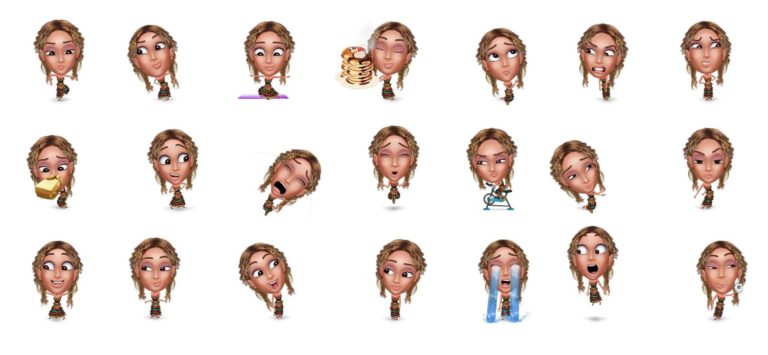
Examples of avatars Genies creates, from Genies.com
These avatars can be used to communicate via dozens of messaging apps (such as Facebook Messenger), all without text, as Genies’ algorithm can detect 180 different emotions in response to text.
Gucci provided haute couture wardrobes for the avatars on their initial venture with Genies. The result was branded experience that felt like fun, rather than advertising, to a generation that increasingly doesn’t respond to traditional forms of marketing.
Example of avatars Genies created for Gucci, from Genies.com
“Current day digital marketing primarily consists of monotonous and passive scrolling through newsfeeds and ads, but marketers should be looking at these tools as ways to break into a more active and personalized way to engage with their customers,” says Sturges.
So are avatars the future of marketing to Gen Z? Only time will tell, but for right now, they’re a great way for brands to at least get in on the conversation.
The Merkle B2B 2023 Superpowers Index outlines what drives competitive advantage within the business culture and subcultures that are critical to succ...
Making forecasts and predictions in such a rapidly changing marketing ecosystem is a challenge. Yet, as concerns grow around a looming recession and b...
The Great Scale-Up: Retailers Going All In on In-Store
2m
ClickZ
The Great Scale-Up: Retailers Going All In on In-S...
In-store retail media is no longer a “does it work?” question. It’s a “can you operate it?” question. At NRF, leaders from CVS, Loblaw, and STRATACACH...
Strategies for Standing Out in the Saturated Podcast Market
2y
ClickZ News Staff
Strategies for Standing Out in the Saturated Podca...
The podcast market is oversaturated, making it challenging for creators to stand out. Effective promotion strategies, including leveraging social medi...
Revolutionizing social media content creation with generative AI: strategie...
2y
ClickZ News Staff
Revolutionizing social media content creation with...
Unleash fresh social media content with generative AI. This article explores using GPTs, AI marvels that craft text based on prompts. Learn best prac...
Exploring the boundless opportunities and challenges of digital marketing i...
2y
ClickZ News Staff
Exploring the boundless opportunities and challeng...
The Metaverse, a virtual platform blending AR and the internet, is transforming digital interactions into immersive experiences. It offers new marketi...
Preparing for the third act: We’re getting marketing personalization all wr...
3y
Nick Masters
Preparing for the third act: We’re getting marketi...
The transition to Web3 and increasing emphasis on anonymity highlights the need for new approaches in content creation, distribution, and engagement w...
Overcoming CX shortfalls across digital channels with (and without!) AI
4y
Cyril Coste
Overcoming CX shortfalls across digital channels w...
Exclusive advice from global influencer and CXO leader, Cyril Coste on how to amp up your customer experience (CX) strategy and connect AI with digita...
Customer experience in 2025: here’s where we’re heading
5y
Chris McGugan
Customer experience in 2025: here’s where we’re he...
By 2025, it’s likely that nine dollars of every $10 will be spent on the digital experience versus phone/voice. Oracle Service's SVP and GM, Chris McG...
How automation solves the problem of product feed and retail ad management
5y
Jacqueline Dooley
How automation solves the problem of product feed ...
Channable is a global retail platform that enables digital marketers, brands, and online retailers to effectively automate and manage their online ret...

Leave a Reply
You must be logged in to post a comment.