What Beauty Brands Must Get Right in 2026: Insights from Christina Kao, Co Founder of Le Mini Macaron
As Gen Z reshapes the beauty landscape, Camelia Beauty Co Founder and Co CEO Christina Kao shares what brands must get right in 2026. From rapid innovation cycles to live selling, in store engagement and global consistency, here are the strategies redefining beauty marketing.
ClickZ sat down with Christina Kao, Co Founder of nail brandLe Mini Macaron, to explore what it will really take for beauty and nail brands to win in 2026.
Over the last 10 years, Le Mini Macaron has grown from a single gel nail kit concept into an international brand with presence in more than 30 markets. The team is based largely in Barcelona, with global distribution across Europe, the United States, Asia and the Middle East, plus retail partnerships with names like Ulta Beauty, Sephora and now Target.
As part of our ongoing effort to give senior marketers exclusive peer insight, we adapted the conversation below from a Q&A session focused on category shifts, Gen Z behavior, and the new rules for profitable growth in beauty.
ClickZ: Going into 2026, what does success look like for Le Mini Macaron?
Christina Kao: Our brand turned ten this past year, and the business looks very different from when we started. Today we have eCommerce in Europe and the US, international distributors, and a growing set of retail partners.
Going into next year, success is very clear for us. We need to amplify what we are doing in the US market. Most of our team is in Europe and we have invested heavily there. The US has always been important, but in the last three to four years it has become a real focus. Now we are doubling down.
We work with Ulta Beauty as one of our key strategic retail partners. We have store expansion with them and two product lines in place. One is our gel manicure line and the other is our Le Sweet nail polish. We are also preparing to launch in Target at the end of February with our Le Sweet nail polish line, which we are thrilled about. Those two retailers are real anchors for us in the US, alongside others.
DTC still matters, but the big priority is making sure US consumers discover us in retail, understand the brand and come back. On the online side, we are very focused on building capabilities around live selling and other formats that can really showcase the product and drive conversion, not just views.
ClickZ: You are active in the US, Europe and Asia. How do you balance local relevance with global consistency as your brand positioning becomes more values driven?
Kao: That has changed a lot over the ten years we have been in market. Early on we were marketing heavily to millennials on Instagram. In recent years, our focus has shifted to Gen Z and Gen Alpha on TikTok and other short form platforms.
What is fascinating is that this younger audience is actually more similar across markets than millennials were. A Gen Z consumer in France, the US or the Middle East is probably seeing the same pop culture moments and beauty trends in real time. Trends go global within 24 hours. If something blows up, it is immediately a worldwide phenomenon.
Yes, there are still local nuances. A French consumer might be more focused on organic and bio-sourced products, while a US consumer may care more about performance and efficacy. But a lot of that segmentation is more relevant to older audiences.
For younger consumers, how they buy beauty has fundamentally changed. They are connected, they learn visually, and they expect brands to show up consistently across platforms. That puts more weight on getting the global brand universe right, then flexing the details per market rather than rebuilding from scratch every time.
ClickZ: How is Gen Z reshaping the way you think about beauty and self expression?
Kao: Older generations were conditioned to think of beauty as perfection. The goal was to reach an aspirational, almost flawless ideal.
For Gen Z, that is not the brief. Beauty is much more about inclusion and self-expression. The question is: “How can beauty support who I already am, rather than turn me into someone else”
We are in color, which is a great playground for that. You can change your nails with your mood, your outfit, your identity on a given day. Younger consumers are not locked into a single look. They like to experiment and switch it up.
Our job as a brand is to give them tools to play with, not a rigid template to conform to. There is no single fixed ideal everyone has to chase. That is a thing of the past. The younger generation is much more confident embracing that, and we see our role as supporting that journey.
ClickZ: What are the core brand pillars you are doubling down on as you rebrand for 2026?
Kao: We are working on a rebranding for spring 2026, and a lot of the work has been asking: what do people really come to us for, and how do we differentiate in the next decade
A few pillars keep coming back.
The first is DIY accessibility. We want our products to be extremely accessible so you do not need a lot of skill to participate. That covers both ease of use and price point. We are very deliberate with pricing because we want everyone to be able to “join the party,” not just a narrow premium segment.
The second is play. Internally we talk about “nail time is playtime.” It is our job to give our community the tools, shades and effects to experiment. That means great product, but also content, tutorials and ideas.
The third is self expression. We want to be the brand that helps you customize your look and change it as often as you like. We are there as a supportive partner, not the star of the show. The customer is the star.
ClickZ: You mentioned that packaging has to sell itself on shelf. How does design fit into your growth strategy and brand loyalty?
Kao:Breakthrough packaging design has been in our DNA from day one. If you look at our original gel manicure kit, the LED lamp is shaped like a macaron. It is unique to us. Many nail brands focus on color and treat the lamp as an afterthought. Ours was conceptual, super cute, and very visual.
The same is true for our nail polish bottles. We carry that design language throughout the line so the brand is recognizable immediately.
Design matters more than ever because there is so much product on the market. It has never been easier to start a beauty brand and get something manufactured. I was at a conference where Ulta Beauty mentioned receiving thousands of indie brand applications every year. If a retailer is looking at that volume, the bar to stand out is high.
Consumers are also extremely savvy. They can research formulas, performance and results across social, reviews and creators. So you cannot rely on function alone. You need an emotional connection and a strong visual story. That is where packaging, storytelling and content all come together.
ClickZ: How do you stay consistent across such different retail environments while still driving discovery?
Kao: It is not easy. Some retailers give you more visual merchandising space and communication. Others give you almost none.
Our philosophy is that every product should be able to sell itself. If it is sitting alone on shelf, the packaging needs to do a lot of the work.
Where we can layer in visual merchandising, we absolutely do. But we also rely heavily on consistent brand expression in social, paid media and sampling. The consumer might see a TikTok, then a paid ad, then a sample, then encounter us in store. We want all those touchpoints to feel like the same world.
We do a lot of photo and video content, and our marketing and creative team is very disciplined about staying within that brand universe. You need that tightness when it can take seven to nine exposures to convert a customer.
ClickZ: Product development in nails moves fast. How do you manage speed of innovation without burning out your team or your partners?
Kao: Nails are a mass category with constant trend cycles. There are always new colors, finishes, nail art accessories and tools. If you want to participate meaningfully, innovation speed matters.
In a perfect world, you might take 18 months to develop a product, align all the stakeholders, and build the campaign. As an indie brand, that is often not realistic.
This past year we did a brand collaboration that went from first meeting to launch in four months. My team would probably say “never again,” but it was a useful signal of what is possible.
More often we aim for something like six months, especially if it is a DTC first launch. That gives us enough time to brief PR, line up influencers, shoot photo and video, build social assets and, where possible, present to retail partners.
The pressure comes from the fact that there are now so many marketing channels to prepare for. You need assets that work in short form video, on product detail pages, in email, and so on. As we grow, we are trying to extend lead times slightly so we can check all the boxes without losing the ability to move fast when a trend hits.
ClickZ: As you scale, how are you distinguishing quality conversions from surface level visibility?
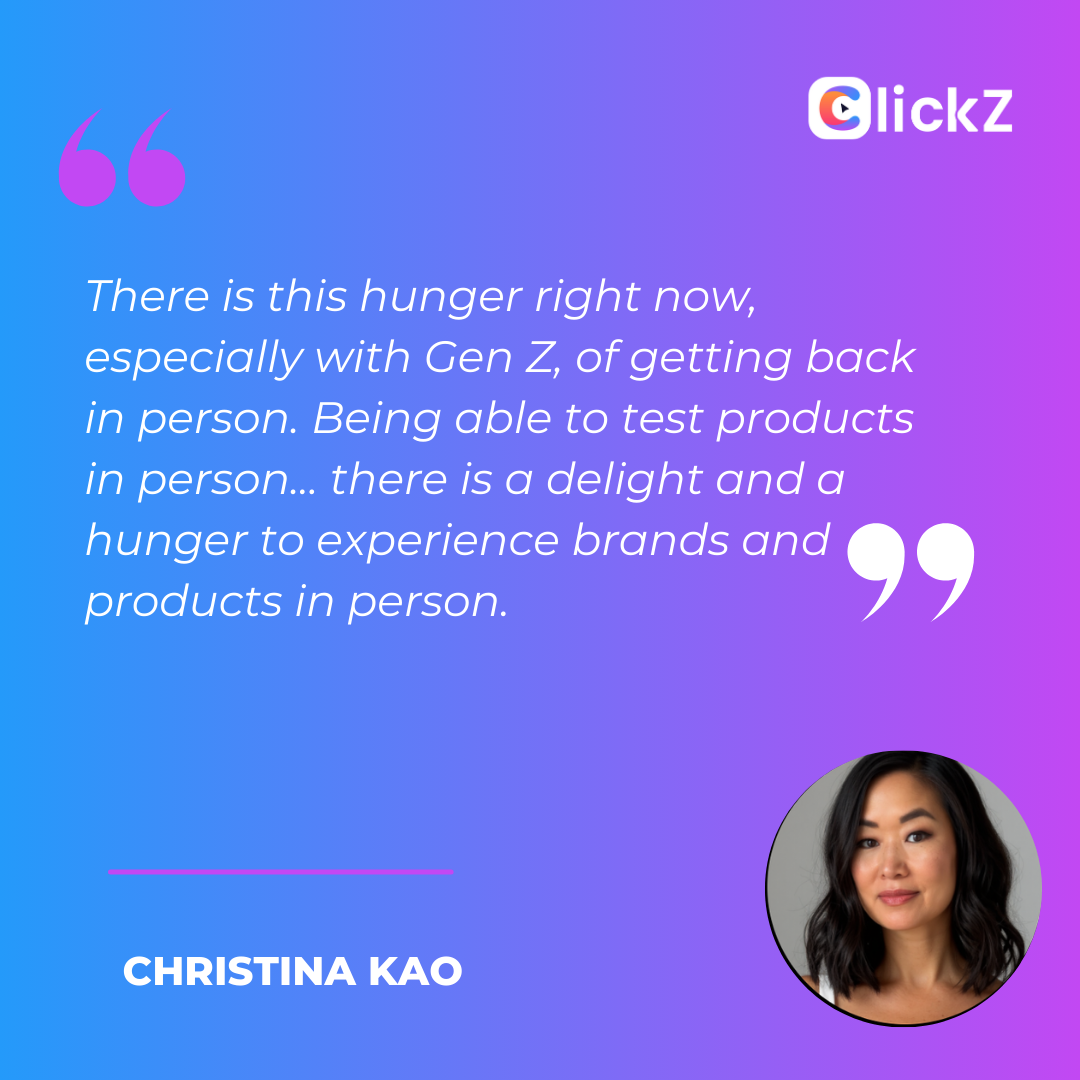
Kao: We are doing a lot more in person activity again, especially in our US retail footprint.
Right now we are in around 700 Ulta stores with our gel manicure line. We recently invested in in store events with a field sales team. When you are physically in front of the consumer, you can educate, answer questions, train store staff and watch the decision process in real time. You see the hesitation, the objections, the excitement. That is incredibly valuable.
We are also participating in press and in store events with Sephora in the Middle East. It is far for us geographically, but it matters. You learn who is actually shopping the brand, how old they are, whether they do nails at home or in salons, and what would make them switch behavior.
Digital is powerful. Tutorials, UGC and education all help. But for us, being live with the customer again, especially post Covid, has been a reminder that conversion is still very human. We bring those learnings back into our broader marketing strategy.
ClickZ: Looking ahead to 2026, what is the single biggest strategic question you are trying to answer as a founder?
Kao: There are two sides to that.
The first is that marketing has become very expensive. Every brand feels it. The question is: how do we get more return on our marketing dollars and drive profitable growth, not just growth for its own sake
That means constantly testing platforms and formats, looking for places where we can see real spikes in performance, then doubling down.
The second is live selling. Whether it is TikTok Shop or other platforms, live selling is still very early in the US. There is a lot of talk about it, especially at events like Beauty Connect, but we are still in the experimentation phase as an industry.
For our category, it feels like a strong fit. Nails are highly demonstrable. You can show results, teach techniques and answer questions in real time. So we are very focused on figuring out which live selling formats and activations can become meaningful growth levers for us as we move into 2026.
Ultimately, it is about testing new things, learning quickly, and being very intentional about where we put our energy so that the brand can keep growing in a sustainable way.
The Merkle B2B 2023 Superpowers Index outlines what drives competitive advantage within the business culture and subcultures that are critical to succ...
Making forecasts and predictions in such a rapidly changing marketing ecosystem is a challenge. Yet, as concerns grow around a looming recession and b...
Why Beauty's Smartest Growth Plays Start With Measurement, Not Media
2m
Zihan Lyu
Why Beauty's Smartest Growth Plays Start With Meas...
Emily Rose Campbell, Head of Performance at Iced Media, explains why beauty brands need to move past ROAS fixation and DTC-only measurement. She share...

Leave a Reply
You must be logged in to post a comment.