As AI tools reshape how people search and platforms like Google return more answers without a click, marketers are being forced to rethink what “visibility” really means. ClickZ sat down with Charlie Clark, founder of SEO agency Minty Digital, to cut through the hype around zero-click search and AI discovery – from what’s genuinely changing in SEO, to why Google still dominates traffic, and what practical shifts marketing teams should be making now to stay competitive.
ClickZ: When people talk about a “zero-click search world,” what do you think they often misunderstand? What’s actually changing versus what’s being overstated?
Charlie Clark (Minty Digital): Especially over the past two years, we’ve seen a change in the search industry larger than we’ve ever seen before, certainly in my professional lifetime. The understanding that most businesses, and not just businesses but consumers, have is wide-ranging. You have some people that think AI is going to completely revolutionize the world and how we operate things. And you have others on the other end of the scale that just say it’s glorified, so to speak.
My position is somewhere in the middle of this because my job, and what our agency does, is optimize for search engines. So whether it is AI search or traditional search engines, we do have an understanding of how these algorithms understand and retrieve and return information. I think there’s more of an understanding the wider audiences are starting to get nowadays, but there’s still quite a way to go.
ClickZ: We’re seeing more than half of Google searches end without a click, yet Google still dwarfs AI tools in total volume. How should marketers interpret that tension between disruption and dominance?
Charlie Clark: One of the biggest misconceptions I’ve seen over the last few years is that when you look at the data, there are more searches happening in AI models for sure. But a lot of these searches are conversational. People are talking to these AI search engines and chatbots more on a conversational level.
Whereas what we see when we look at the data with a lot of our clients is, yeah, Google absolutely dominates still when it comes to traffic and conversions. To give you an idea, I’ve not seen a single one of our clients have more than 4% of their traffic come from AI search at the moment.
But what is interesting is the topic of conversation today is how many of these are zero clicks. Even before people come through to the website, there’s a whole other level now of top of the funnel research and conversations that customers are having. The next evolution, certainly for what we do in SEO, but also marketers in general, is making sure that you’re appearing across those touch points that you can’t necessarily see on your analytics dashboard.
ClickZ: From an SEO perspective, what parts of the traditional playbook still matter just as much as they did three to five years ago, and what clearly doesn’t?
Charlie Clark: The fundamentals of SEO are still the same. Good SEO underpins both traditional search visibility, but also AI search visibility.
You can break it down into three sections. You’ve got your technical SEO, which is like the engine of your website. You need to make sure it’s being indexed, readable, and understood by AI crawlers and traditional search. You’ve got your links and your mentions, your authority. You need to make sure you have authoritative sources talking about you, linking to you, mentioning your brand name. And the content that you produce needs to be written in a way that is understandable both by humans and these search engines. Tied together, that sets the foundations for optimizing in the AI search world.
Things that are not working anymore, or are slowly starting to be fizzled out, are tactics that people use to manipulate search engines, like spamming with backlinks or keyword stuffing. Those old school tactics are getting outdated. People need to move away from that and start thinking about how they do good marketing rather than cutting corners.
ClickZ: AI search tools prioritize authority, brand mentions, and community signals more than classic blue link rankings. How does that change the way brands should think about “visibility” if users never reach their website?
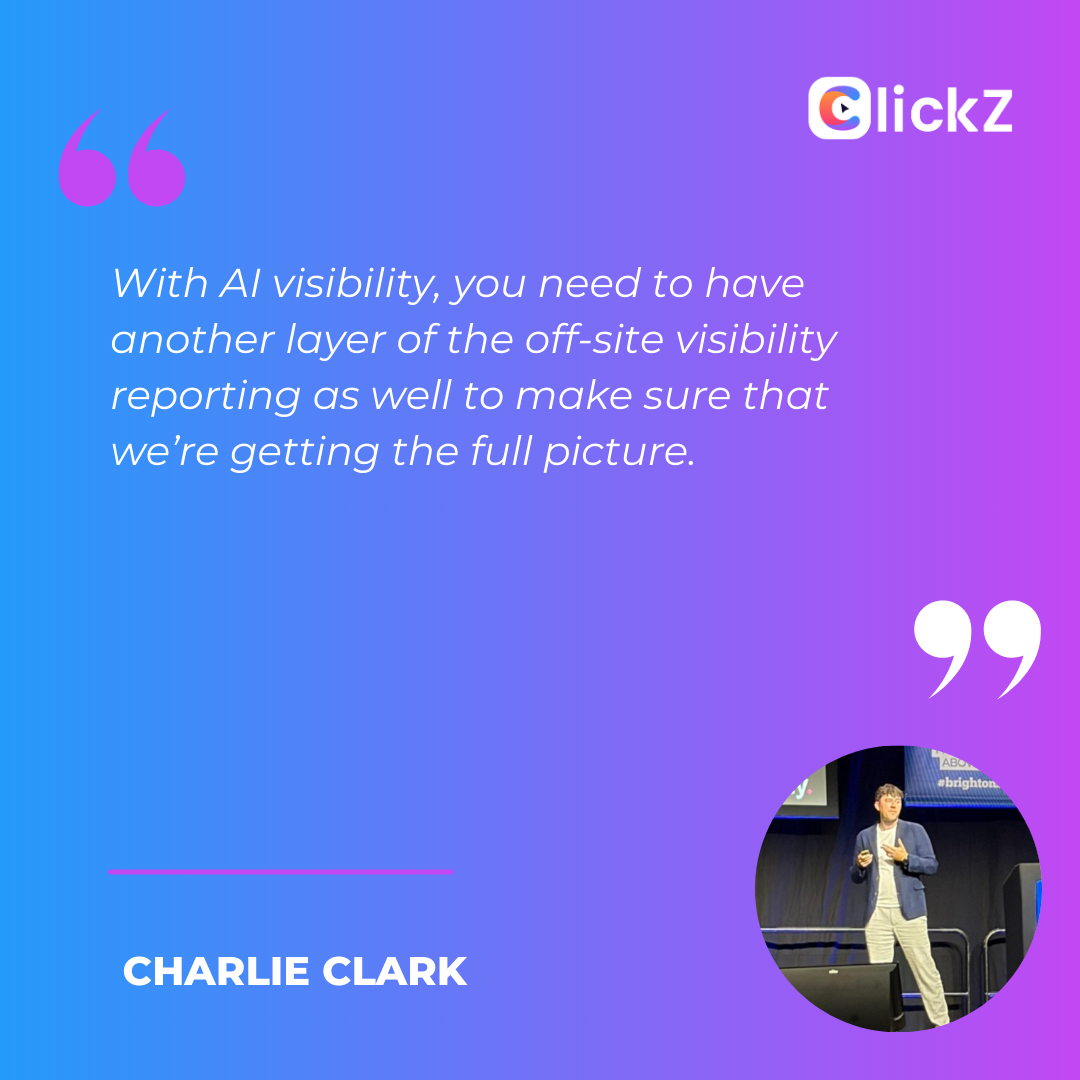
Charlie Clark: We break down reporting into two different sides with the clients we work with now. We still have the on-site elements, which are clicks, traditional rankings, click-through rates, et cetera. They’re still important. But with AI visibility, you need another layer of off-site visibility reporting as well to make sure you’re getting the full picture of everything happening off site.
Some of the metrics we encourage people to implement and track are share of search, what your share of search is compared to your competitors, and how many impressions you’re getting. And what’s really important is whether your brand’s getting cited, mentioned, or surfaced in AI answers.
What you want to do is get the keywords, the search terms, or the prompts that your users might be typing into these search engines. You can do this manually, but there are visibility trackers available. What you’re able to do is monitor your visibility for those search terms, and also see the sources being cited. Then you’re able to get your brand injected there, and create content that’s better than what’s being sourced. There’s a whole other element of optimization tactics to think about now.
ClickZ: Minty works closely with eCommerce brands. Can you share an example of a retail or DTC brand you’ve helped adapt its SEO or content strategy to account for zero-click results or AI-driven discovery? What specifically changed, and what impact did it have?
Charlie Clark: We have one eCommerce brand that we’ve been working with, and it’s important to state that we’re not completely replacing our strategies. The fundamentals I mentioned earlier are still essential, because without them, you’re not going to be visible in AI search at all. If you want to take this a step further and start doubling down on how you optimize for these AI search engines, one of the strategies we’ve implemented is reverse engineering the prompts. We’ll get all of our search terms and prompts that people might be typing into the search engines, map out hundreds of sources that are being used, and then bucket them into the departments responsible for going after them.
For example, Reddit. We could highlight 100 Reddit threads that are being sourced, and we’re able to inject our brand into those conversations and start to change a narrative. Listicles or brand reviews are also very popular sources for AI search engines. If we’re not featured in those reviews or listicles, we’ve done this recently for an eSIM brand that we work with, we reach out and see if we can get our brand featured there, and preferred there.
Ultimately, what we’re looking to do is take up that share of voice and increase the amount of citations we’ve got in AI search engines. From there, you can monitor visibility week on week, month on month. The more sources you’re getting covered, the more visibility you’re getting for your brand. That’s been a really successful tactic for us, and it’s something that’s helped get us shortlisted for a number of awards in the last year.
ClickZ: Do you work with B2B companies as well, and does AI search change the approach?
Charlie Clark: Yeah, we work with a number of B2B companies, like law firms and some IT consultancies. What’s interesting is that for the more B2B style companies we work with, AI overviews and AI search are affected, but nowhere near as much as some of the other industries. But the tactics are still the same. The aim of the game is to increase that share of search in the AI search engines. Reverse engineering the prompts, sticking to the SEO fundamentals, that is the way we do it.
ClickZ: With features like in-chat checkout and agent-led shopping emerging, do you see AI becoming a true revenue channel for brands, or mainly a discovery layer that feeds other platforms?
Charlie Clark: One of the most interesting developments I’ve seen in the last two weeks is, first, Google have now partnered with a multi-year deal with Apple to replace Siri. Second, Google have also announced they’re running a partnership to connect at more like an API level. They’re generating a standard protocol to connect with Shopify, Etsy, Wix, basically all of the big eCommerce platforms, so that these stores can communicate directly with Google without them having to leave the first page of Google.
The way I see this evolving very quickly is that sooner or later you’re going to be able to go into AI mode on Google. Your credit card is already going to be linked up to Google. You’ll be able to search, get personalized results across multiple different stores, break that down by reviews and other factors, and purchase directly within AI mode without ever leaving the platform. They’re trying to reduce the number of clicks you need to make to get to the checkout and make that purchase. One of the ways this is going to be rolled out is via Google Merchant Center. So for eCommerce brands that do not have their merchant centers set up and optimized, I would say start doing it. Get it set up today because that is going to be the way things are going for eCommerce brands in the very near future.
ClickZ: Younger users are adopting AI search fastest and spending less time evaluating sources. How should brands adjust messaging, content formats, or trust signals for this audience?
Charlie Clark: There’s a lot of misinformation out there, and I imagine you’ve had it, I’ve had it, where ChatGPT will give you a wrong answer, you know it’s the wrong answer, and you question ChatGPT and then it’s like, sorry, this is the right answer instead. I think Google was like this when it first launched, and it’s gone through iterations even in the past few years.
What the AI crawlers and chatbots return is relatively out of our control. The biggest takeaway I would have for brands looking to engage and build trust with these audiences is once they’re on your site and you’ve introduced them to your brand, really double down on first-party data marketing. If you’re getting emails, if you’re getting numbers, keep your audience engaged once they’re in through as much real life content as you can. We post brand interviews, we make in-real-life-type YouTube stories, that kind of thing.
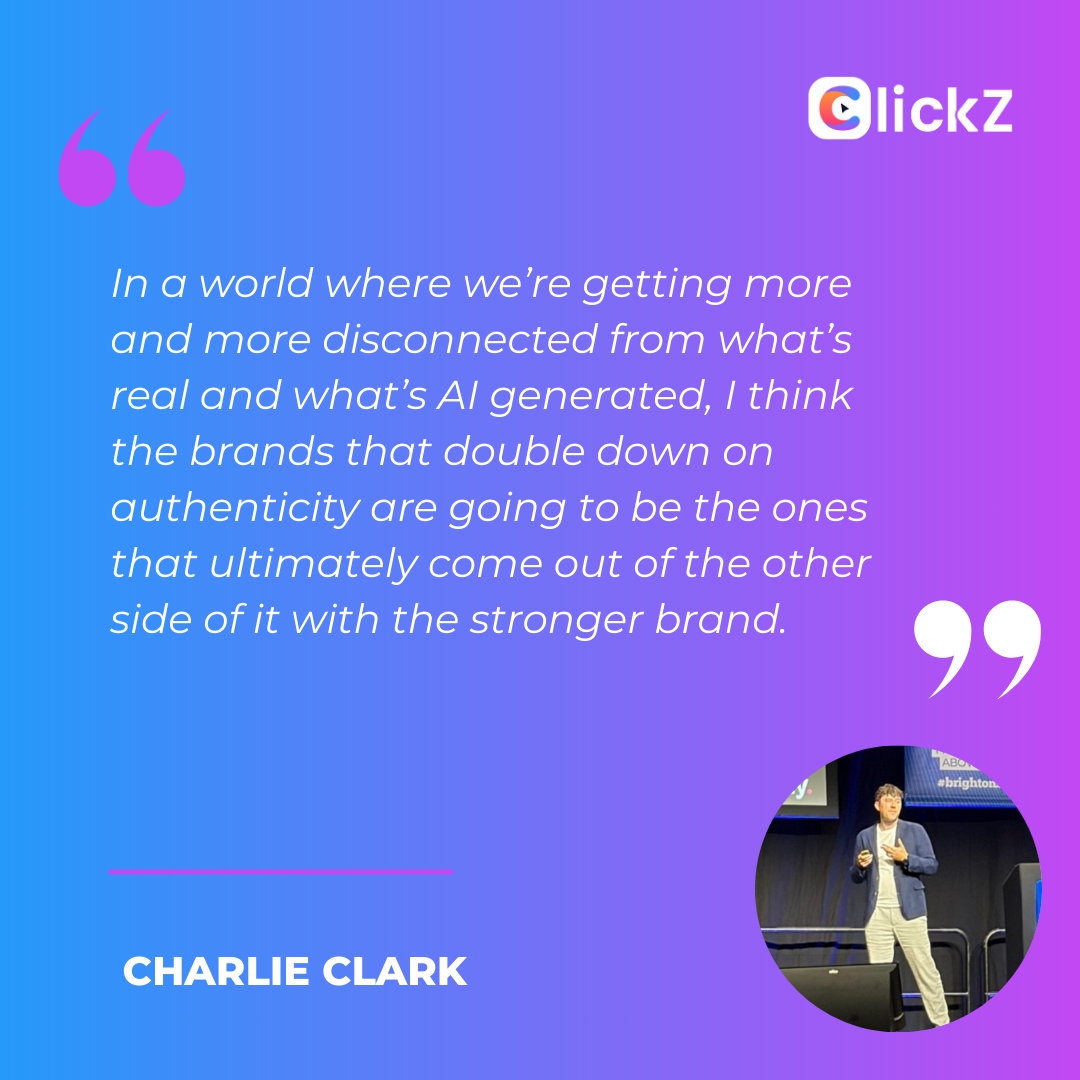
In a world where we’re getting more and more disconnected from what’s real and what’s AI generated, I think the brands that double down on authenticity are going to be the ones that come out of the other side of it with a stronger brand.
ClickZ: If you were advising a marketing team with limited resources, what would be the top two or three practical changes you’d prioritize in the next 12 months to stay competitive in search?
Charlie Clark: One of the quickest wins would be repurposing existing content rather than consistently wanting to create more new. A lot of brands put great content on the site like old interviews and old content that can be evergreen. Some articles need to be updated, but a lot of evergreen content can be pulled apart and repurposed to YouTube Shorts, Instagram Shorts, TikTok, email. People are on different channels now. There are tools where you can upload a piece of content and it will support generating things like Shorts. You don’t need to hire a full-time editor. Repurposing across different channels can reach new audiences cost effectively and time effectively.
Second would be trying not to get too involved in shiny object syndrome. Double down on the fundamentals. You don’t always need to buy the latest software or tools, or the latest AI agent to get things optimized. Sometimes if you stick to the fundamentals and what’s worked for years, you get a better outcome than spending a portion of money and time trying to build an AI agent to replace your social media strategy.
The last thing would be to start monitoring beyond just Google. AI visibility trackers, there are a number of them out there. Some are expensive, but some you can get for under £100 a month. You can start seeing where your brand’s being cited, where it’s being sourced, where your competitors are being cited, and you can start putting together a strategy about how to combat that long-term. You are going to need this as part of your marketing strategy moving forward. It’s non-negotiable.
ClickZ: Looking ahead, when we talk about success in search marketing in 2030, what metrics or outcomes do you think will matter the most?
Charlie Clark : I’ve been around for 10 years and seen agencies come and go. Good marketing and good brand always win. I’ve seen ones that take the shortcuts and try to get a quick option to the top. They might get there for the time being, but the ones that take shortcuts and don’t focus on good brand and good marketing normally end up coming second place.
My advice is always to double down on those fundamentals. You look at brands that have lasted decades, they’ve all done the same thing. No matter the changes in technology, economy, or any other challenge that can come up, the ones that have stuck to that have always been the ones that have succeeded. And I think that will be true at least until 2030.
Leave a Reply
You must be logged in to post a comment.